
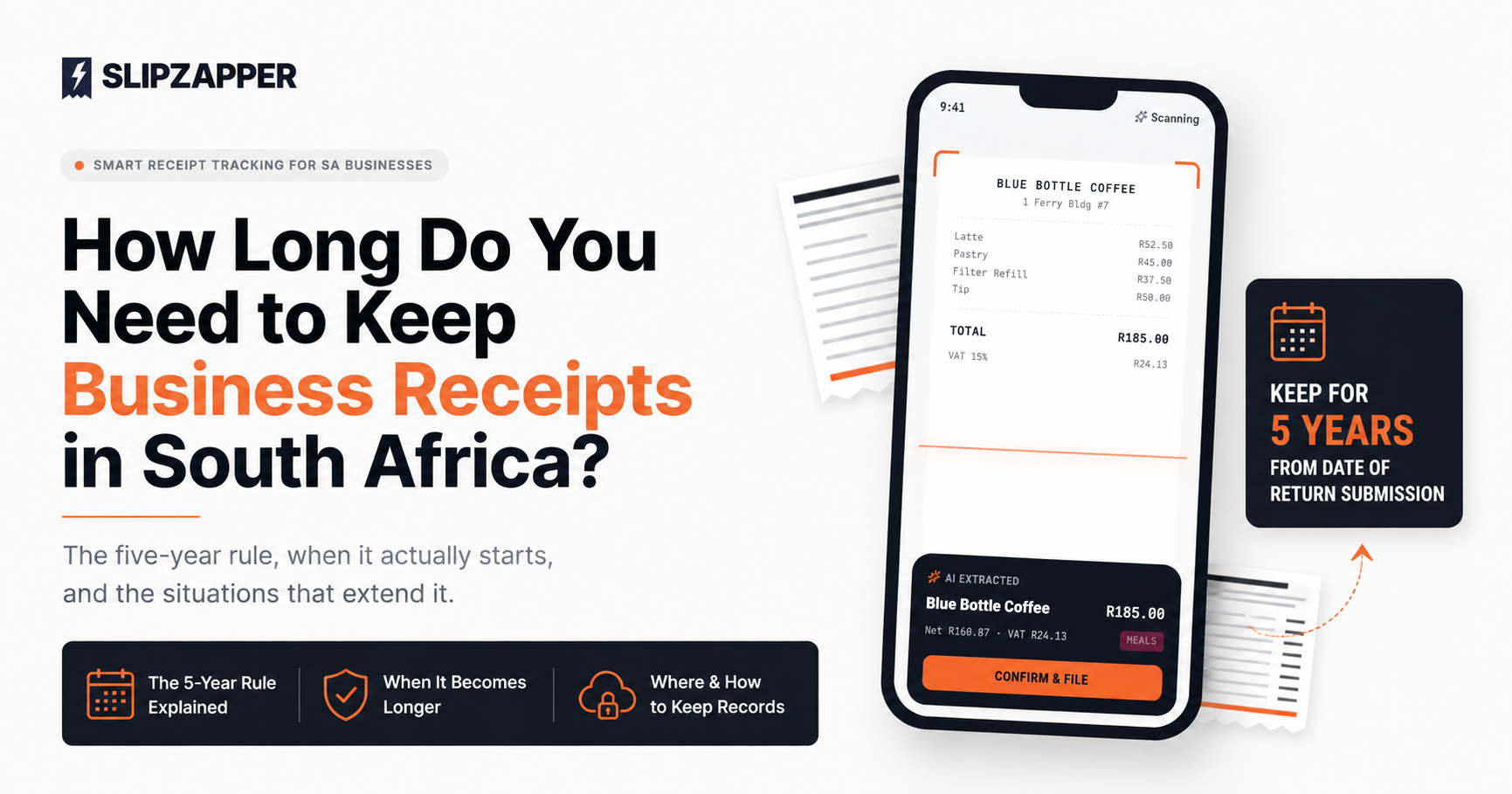
How Long Do You Need to Keep Business Receipts in South Africa?
The short answer is five years. The honest answer is "five years, except when it's longer," and knowing which situation you're in matters more than the headline number. Here's how the rule actually works.
The five-year rule, and when it starts
Under Section 29 of the Tax Administration Act, taxpayers must keep records, books of account, and supporting documents for five years. The part people often get wrong is the starting point: the clock doesn't start on the date of purchase, it starts from the date you submit the relevant tax return.
So a fuel slip from March, supporting an expense claimed on a return you only submit the following February, is kept for five years from that February submission date, not from March. In practice this means some receipts sit in your records for closer to six years once you count the time between the expense and the filing.
If no return was required for a particular period but you still received income, incurred a capital gain or loss, or carried out a taxable activity, the same five-year obligation still applies, counted from the end of that relevant tax period instead.
When five years quietly becomes longer
Three situations extend the clock, and all three are common enough that it's worth planning for them rather than being caught out.
An audit or investigation. If SARS notifies you of an audit, you're required to keep the relevant records until that process is fully concluded, even if it runs well past the standard five years.
An objection or appeal. Same logic. If you're disputing an assessment, hold onto every supporting document until the dispute is finalised.
Certain Companies Act records. Separately from tax records, some company documents (founding documents, share registers, and similar) carry their own retention periods under the Companies Act, in some cases up to 15 years. These aren't your everyday receipts, but if you're a director, it's worth knowing "five years" isn't a blanket rule for every document your business holds.
The practical rule of thumb: if a return is still open in any way (being reviewed, queried, disputed, or audited), don't archive or delete anything tied to it, regardless of how much time has passed.
Where and how records need to be kept
SARS accepts records in original paper form or in an acceptable electronic format, and electronic records are increasingly the norm. A few requirements worth knowing:
- Electronic records must maintain their integrity and remain easily accessible for inspection throughout the retention period.
- They generally need to be stored within South Africa, unless a senior SARS official has specifically authorised storage elsewhere.
- The record needs to still be usable at the end of the period, not just present. A file in a format nobody can open anymore, or a login to a service you've since cancelled, doesn't meet the requirement in any practical sense.
A retention habit that actually survives five years
Most retention failures aren't dramatic. Nobody deletes a folder on purpose. It's a laptop that gets replaced, an email account that gets migrated, a thermal receipt that fades in a drawer, or an app subscription that lapses and takes the data with it. Five years is a long time for any single point of storage to survive untouched.
The safer approach is to capture the receipt digitally the moment it exists, and store it somewhere that isn't tied to one device, one inbox, or one employee's phone. That's the problem SlipZapper is built to solve: every slip captured through the app, WhatsApp, or email is read, filed, and stored centrally against your company's records, not scattered across individual phones and inboxes. When SARS asks for a document from three years ago, it's a search, not a scavenger hunt.
Start your 30-day free trial →
Related reading: SARS Receipt Requirements: What You Actually Need to Keep · The Real Cost of Lost Receipts for SA Businesses
This article is general guidance and not a substitute for advice from a registered tax practitioner. For specific situations, consult SARS directly or your accountant.