
SARS Receipt Requirements: What You Actually Need to Keep
"Keep your receipts" is easy advice to give and surprisingly hard to follow properly. Which receipts? For how long? Does a bank statement count? Does a photo of a faded slip count? Here's the plain-English version of what SARS actually requires, so you're not guessing at tax season.
What counts as a valid tax invoice
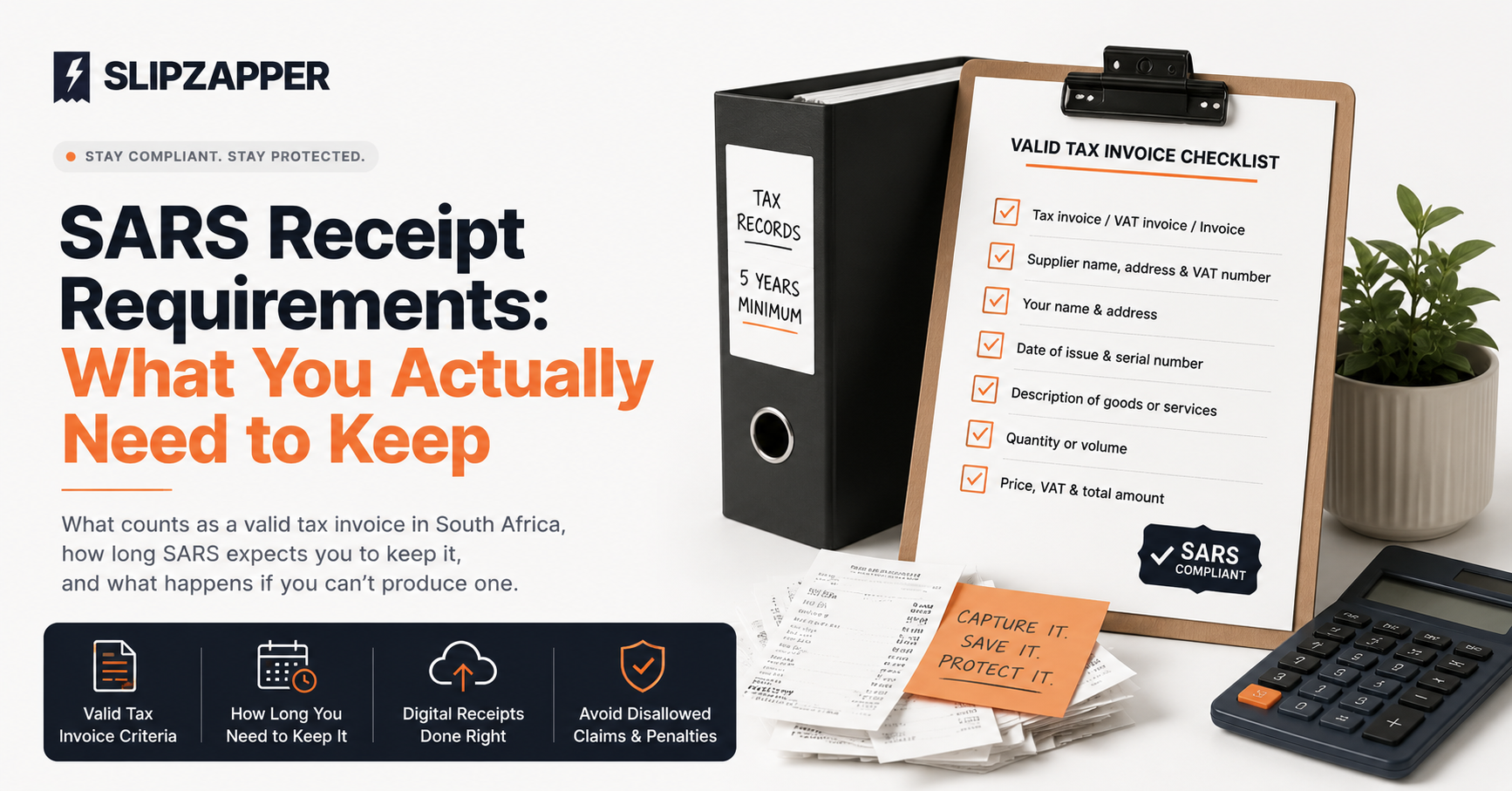
If you're VAT-registered and want to claim input tax, a bank statement or till slip on its own generally isn't enough. SARS requires a proper tax invoice, and for supplies over R5,000, that invoice needs to include:
- The words "tax invoice", "VAT invoice", or "invoice"
- The supplier's name, address, and VAT registration number
- Your name and address (as the recipient)
- A serial number and the date of issue
- A description of the goods or services
- The quantity or volume of what was supplied
- The price, the VAT charged, and the total amount
For smaller purchases under R5,000, the rules relax slightly. A simplified tax invoice is acceptable, and it can leave out your details as the buyer, though it still needs the supplier's details, VAT number, a description, and the VAT-inclusive total.
The practical takeaway: a random EFT confirmation or a card statement line isn't a tax invoice. It might tell you that money left your account, but not why, and SARS wants both.
How long you need to keep it
Under the Tax Administration Act, the standard rule is five years from the date you submit the relevant return. That covers ledgers, cash books, electronic data, and every supporting document behind them, including receipts and invoices.
There are two important exceptions worth knowing:
If SARS opens an audit, objection, or dispute on a return, the five-year clock effectively pauses. You need to hold onto the relevant records until that process is fully resolved, even if it drags on well past year five.
Certain company records under the Companies Act run longer, in some cases up to 15 years for specific categories like founding documents and share registers. That's less relevant to day-to-day receipts, but worth knowing if you're a director assuming "five years" covers everything.
Digital receipts are fine, as long as they're actually usable
SARS accepts electronic records, provided they're stored in a way that keeps them accessible and intact for the full retention period. A few practical implications:
- A photo of a thermal receipt is fine, but thermal ink fades over months. If the only copy you have is the physical slip, it may be unreadable by the time anyone needs it. A digital copy taken early solves this.
- Electronic records generally need to be stored within South Africa, unless SARS has specifically authorised an offshore location.
- Relying on "it's in my email somewhere" isn't a records system. If your inbox gets cleaned out, migrated, or the account gets closed, that receipt is gone. Exporting records after each return period is the safer habit.
What happens if you can't produce one
Two things, neither pleasant. First, without a valid tax invoice, SARS can disallow the VAT input claim or the income tax deduction tied to that expense, meaning you pay tax on money you genuinely spent for business purposes. Second, if you're audited and records are missing entirely, that's a compliance problem in its own right, separate from any individual claim, and can affect your standing with SARS more broadly.
Neither outcome comes from bad intentions. It's almost always a paper trail that quietly fell apart: a slip that faded, a WhatsApp photo nobody saved properly, a folder that didn't survive a laptop change.
The fix is capturing the receipt the moment it exists
The businesses that never scramble for a missing invoice all do one thing: they digitise the slip immediately, not at month-end. That's exactly the gap SlipZapper closes. Snap a slip in the app, forward it over WhatsApp, or email it in, and the AI reads the supplier, VAT number, amount, and category on the spot, then files a clean digital copy alongside the transaction. Nothing fades, nothing lives only in someone's camera roll, and nothing gets lost in an inbox cleanup three years from now.
Start your 30-day free trial →
Related reading: The Real Cost of Lost Receipts for SA Businesses · How Long Do You Need to Keep Business Receipts in South Africa?
This article is general guidance and not a substitute for advice from a registered tax practitioner. For specific situations, consult SARS directly or your accountant.