
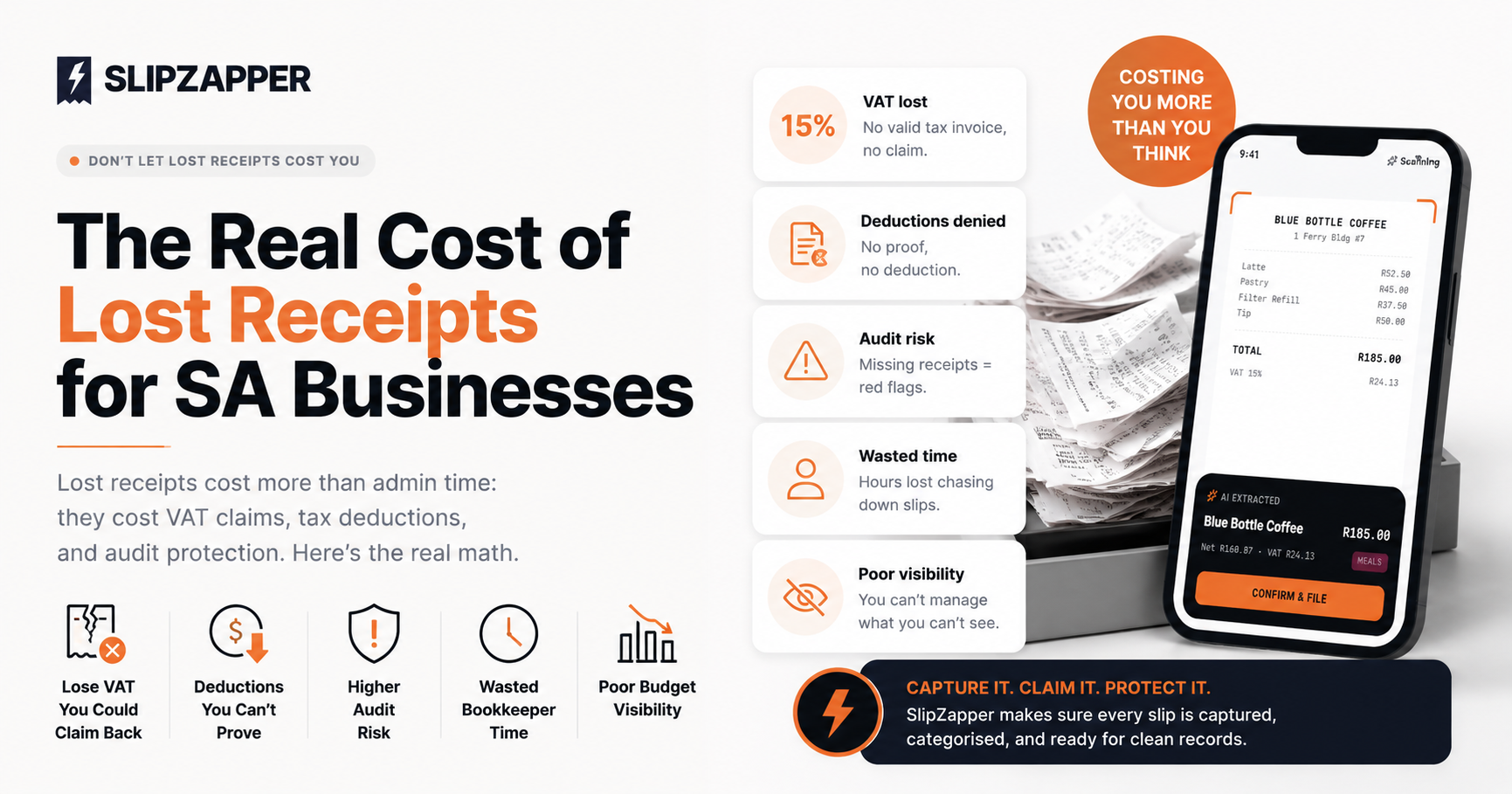
The Real Cost of Lost Receipts for SA Businesses
Every business owner has a version of the same drawer. Crumpled thermal slips, a couple of PDF invoices buried in someone's inbox, a WhatsApp photo of a fuel receipt nobody ever downloaded. Individually, none of it looks like a problem. Collectively, it's costing you money, and probably more than you think.
Here's what a "missing receipt" actually costs, broken down.
1. You lose the VAT, not just the receipt
This is the one that stings most. In South Africa, VAT is charged at 15%, and if you're a VAT-registered vendor, you can claim that back as input tax, but only if you hold a valid tax invoice to prove it. No invoice, no claim. SARS doesn't accept "I definitely bought it" as a substitute for paperwork.
So every lost slip isn't just a filing headache. It's 15% of that expense, gone, permanently. Lose a handful of R500 slips a month across a team of five, and you're quietly writing off thousands of rands a year in VAT you were legally entitled to claim back.
2. Deductions you can't prove are deductions you don't get
The same logic applies to income tax. If an expense isn't properly documented, it's harder to defend as a legitimate business deduction, whether that's client entertainment, travel, or software subscriptions. Come tax season, an unsupported expense either gets left out of the return entirely (you lose the deduction) or gets claimed anyway and becomes a liability if SARS ever asks for proof.
Neither outcome is good. One costs you now. The other costs you later, with interest and possibly a penalty attached.
3. Audit risk goes up, not down
Under the Tax Administration Act, businesses are required to keep supporting records for five years from the date a return is submitted (longer if a return is under dispute, audit, or objection). That's five years where a missing receipt isn't just an inconvenience, it's a gap SARS can flag.
A shoebox full of thermal paper doesn't help here either. Thermal receipts fade. A receipt you do still have might be unreadable by the time anyone needs it, which for audit purposes is functionally the same as not having it at all.
4. Your bookkeeper's time isn't free
Every month-end, someone has to chase down what a R340 charge on the card statement actually was. That's time your bookkeeper (or you) spends reconstructing history instead of doing the job you're paying them for. Multiply that by every cardholder, every month, and "just a bit of admin" turns into hours of billable or opportunity cost that never shows up as a line item anywhere, but is very real.
5. Budget visibility disappears
If expenses only get captured weeks after they happen, you're not managing a budget: you're doing archaeology. Overspend on a category doesn't get caught until it's already happened, because nobody had a real-time view of what was going out the door. By the time the spreadsheet catches up, the quarter's already over.
So what does "fixing" this actually look like?
The businesses that don't have this problem share one habit: the slip gets captured the moment it exists, not weeks later. Not "at month-end when I remember." Not "when the drawer gets full." The second the card is swiped.
That's the entire idea behind SlipZapper. Snap a slip in the app, forward it over WhatsApp, or email it in, and the AI reads the merchant, amount, VAT, and category in seconds, before it has a chance to get lost, faded, or forgotten. VAT sits on its own line automatically, ready for a clean Xero, QuickBooks, or Sage export. No shoebox. No chasing. No silently writing off VAT you were owed.
Start your 30-day free trial →
Related reading: SARS Receipt Requirements: What You Actually Need to Keep · How Long Do You Need to Keep Business Receipts in South Africa?