
If your business issues company cards, you already know the trade-off. On the one hand, important business functions can run smoothly and seamlessly without going through a finance approval process each time, but on the other hand, it has its risks and can result in an admin nightmare.
Most South African SMEs land on one of two extremes. Either there's no real policy at all, and cards get used for whatever seems reasonable at the time, or there's a policy so strict that cardholders route around it, submitting expenses through personal accounts because asking for approval takes too long. Neither works. Here's what actually does, and how to set it up without creating a second full-time job for your bookkeeper.
Why "we trust our team" isn't a policy
Trust is not the problem. Visibility is. A cardholder buying stock, fuel, or client lunches on the company card almost always has a legitimate reason for the purchase. The issue is that the business owner or finance person usually only finds out what happened weeks later, when the bank statement lands and someone has to reconstruct a month of spending from memory and a pile of slips.
By then, three things have usually gone wrong:
- A few slips are missing, so the VAT on those purchases can't be claimed.
- Nobody flagged the purchase that was outside policy, because nobody was watching in real time.
- The bookkeeper is now doing detective work instead of bookkeeping.
None of this is a discipline problem. It's a timing problem. Policies fail when the checks happen too late to matter.
What a company card policy actually needs to cover
A working policy answers three questions, clearly enough that a cardholder never has to guess:
- What can this card be used for? Be specific. "Business expenses" is not a policy. "Fuel, client meals up to a set amount, and approved software subscriptions" is.
- What needs sign-off, and from whom? Not every transaction needs a manager's approval before it happens, but some should, especially above a certain amount.
- What happens if someone goes over budget or off policy? This should be defined before it happens, not negotiated after the fact.
The mistake most businesses make is writing this down once, distributing it, and assuming that's the end of it. A document doesn't enforce anything. The card needs to enforce it.
Turning the policy into something that actually runs itself
This is where the card and the software behind it matter more than the wording of the policy document. SlipZapper was built around the idea that oversight should happen at the moment of the transaction, not weeks later during a reconciliation scramble.
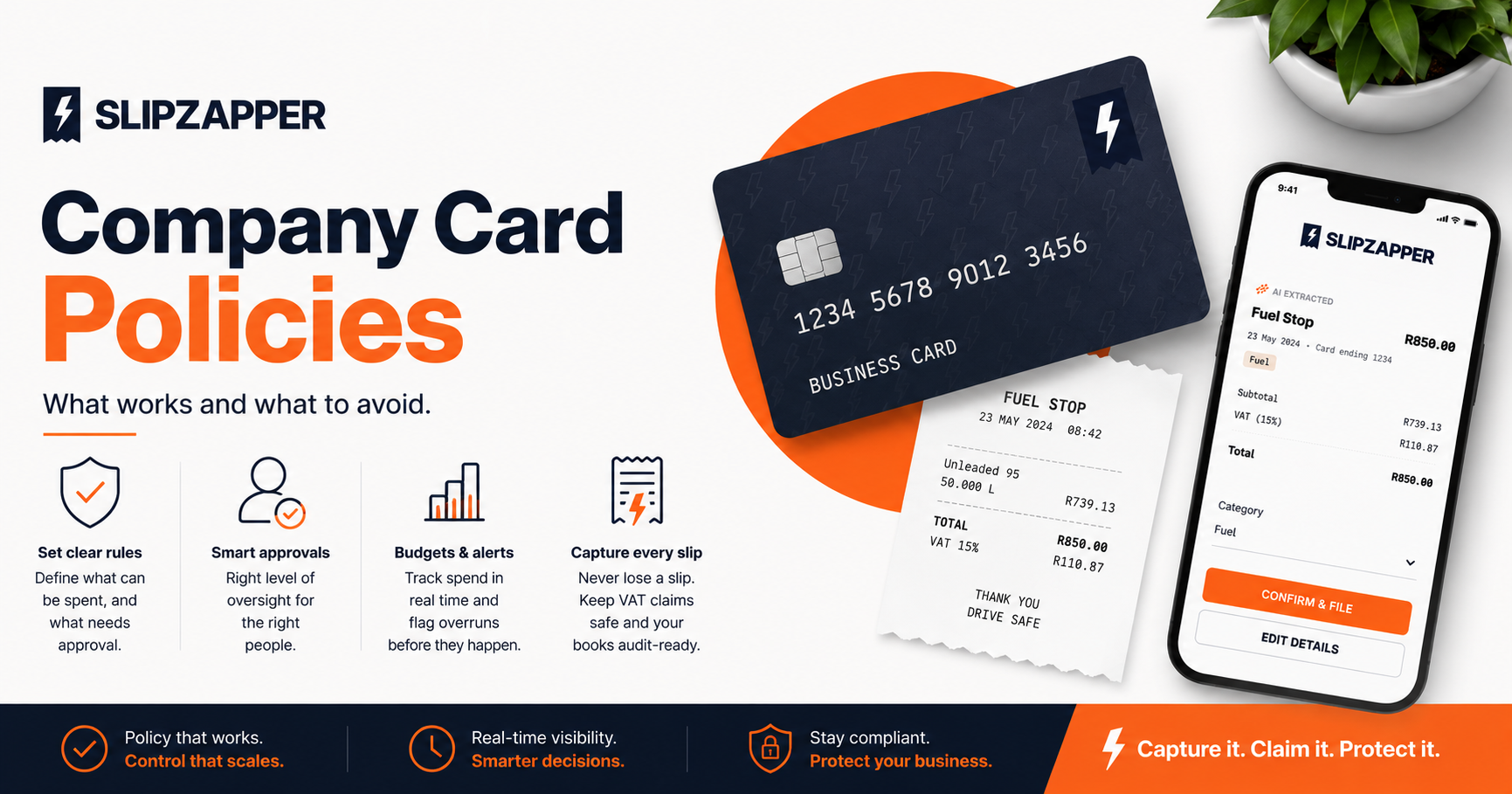
Categories that match your actual policy, not a generic list. SlipZapper gives you full control to create and manage your own expense categories, so "what this card can be used for" stops being a line in a document and becomes something the system actually enforces. Each category can also be set to count toward a card's budget or not, so you can track spend on something for visibility without it eating into the number that triggers an overrun warning.
Approvals, switched on per card, not per business. Not every card needs the same level of oversight. A director's card might run without friction, while a new hire's card or a card used for irregular purchases can have approval switched on. When it's active, every transaction on that card shows its status clearly: approved, pending, or flagged. There's no ambiguity about what's been signed off and what's still sitting in someone's queue. This gives you the control of a strict policy without applying it uniformly to people who've already earned some latitude.
Budgets that show where you're headed, not just where you are. A budget that only tells you what's been spent so far is not that useful on its own, because by the time you're over budget, you're already over budget. Set a budget per card, and if recurring transactions have been set up, SlipZapper projects where that card is tracking to land by month-end, not just where it stands today. Potential overruns get flagged in advance, while there's still time to do something about it. That's the difference between a budget as a record and a budget as a warning system.
Capture at the point of sale, not at month-end. The core of SlipZapper is simple. Cardholders capture their slip as the transaction happens, whether that's a photo, a forward from email, or a message to the WhatsApp bot. That single habit is what makes everything else possible. No VAT gets lost because every slip is on record. Your books stay tax compliant because there's a paper trail for every transaction, not a gap where "I'll find that slip later" used to be. And month-end stops being a scramble, because the reporting has been building itself in real time all along.
Putting it together
A policy that lives only in a document gets ignored eventually. A policy that's built into the card, with approvals where you need them, budgets that warn you before they break, and slip capture that happens the moment money moves, doesn't need to be enforced. It just runs.
If you're setting up company cards for the first time, or fixing a policy that's stopped working, start with the cards that carry the most risk. Switch on approvals there first. Set a budget. Get your cardholders into the habit of capturing slips as they go. The rest tends to fall into place once that foundation is in.
Ready to put this into practice? Start your 30 day free trial and get your cards set up with approvals, budgets, and real-time slip capture from day one.